Types of SEO: On-Page, Off-Page and Technical SEO Explained


Types of SEO: On-Page, Off-Page and Technical SEO Explained
TL;DR
The three main types of SEO are on-page SEO, off-page SEO and technical SEO. On-page SEO improves the content and HTML of each page, off-page SEO builds trust through links, mentions and reviews on other sites, and technical SEO makes sure search engines can crawl, render and index your site. Specialized types such as local SEO, ecommerce SEO and GEO for AI search build on these three. You need all of them working together: strong content will not rank on a site Google cannot crawl, and a fast site will not rank without content and authority.
Key takeaways
- On-page SEO is what you write. Keywords, titles, headings, content and internal links on each page.
- Off-page SEO is what others say about you. Links, brand mentions and reviews on other websites.
- Technical SEO is the foundation. Crawling, indexing, speed, mobile version, HTTPS and structured data.
- Specialized types solve specific goals. Local SEO for nearby customers, ecommerce SEO for stores, GEO for AI answers.
- Fix in the right order. Technical base first, then on-page, then off-page, with regular checks for all three.
SEO is not one task. It is a set of different jobs that affect how search engines see your site. Some happen on your pages, some happen on other websites and some happen in the code and server settings that visitors never see.
This guide explains the main types of SEO, the difference between on-page and off-page SEO, where technical SEO fits in and how to combine them into one plan.
What Are the Main Types of SEO?
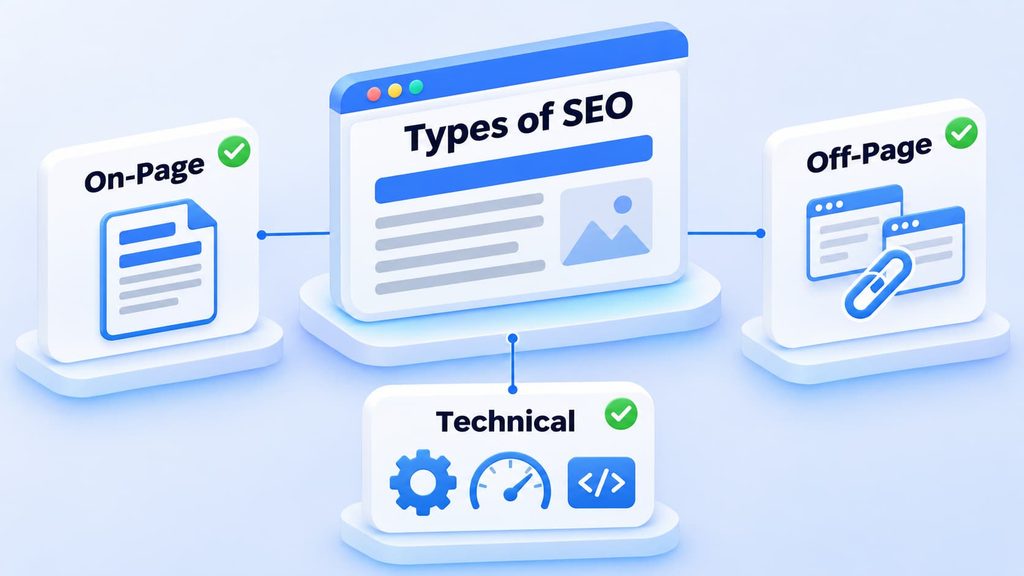
There are three core types of SEO:
- On-page SEO: everything you optimize on the page itself.
- Off-page SEO: signals from outside your site that show trust and popularity.
- Technical SEO: the setup that lets search engines access and understand your site.
On top of these, there are specialized types for specific goals: local SEO, ecommerce SEO, and GEO and AEO for AI search. They use the same three foundations, but focus on different results and different search features.
On-Page SEO
On-page SEO is the work you do on each page so that search engines and people understand what it is about and why it is useful.
It includes:
- Keywords: one main topic per page, plus related terms. See our guide on how many keywords to use for SEO.
- Title tag and meta description: a clear title with the main keyword and a description that makes people click.
- Headings: one H1 and logical H2 and H3 headings that follow the questions readers have.
- Content: complete, accurate answers, examples and visuals that match search intent.
- Internal links: links to related pages with descriptive anchor text.
- Images: descriptive file names and alt text.
A good place to start is a content brief for each page. Our SEO content brief guide shows how to plan headings, keywords and questions before you write.
Off-Page SEO
Off-page SEO covers everything outside your site that tells search engines your content is trusted. The main parts are:
- Backlinks: links from other relevant, trusted websites. Quality matters more than quantity.
- Brand mentions: your name in articles, lists and reviews, even without a link.
- Reviews: on Google Business Profile, industry platforms and marketplaces.
- Digital PR and partnerships: expert comments, guest articles, podcasts and partner pages.
Off-page SEO also builds brand awareness, because people see your name on sites they already trust. Read more in our guide to SEO for brand awareness, or see how we approach link building.
Technical SEO
Technical SEO makes sure search engines can find, crawl, render and index your pages without problems. It includes:
- Crawling and indexing: a clean XML sitemap, correct robots.txt, no important pages blocked by noindex.
- Site speed: fast loading on mobile and desktop.
- Mobile version: the full content and links work on phones.
- HTTPS: a secure connection on every page.
- Duplicate content control: canonical tags and redirects for duplicate or moved pages.
- Structured data: schema markup that describes your business, articles, products and FAQs.
Technical problems often appear after a redesign or platform change. If you plan one, use a website migration SEO checklist first.
On-Page vs Off-Page SEO: Key Differences
| Aspect | On-page SEO | Off-page SEO | Technical SEO |
| Where it happens | On your pages | On other websites | In site code and server settings |
| Main goal | Relevance to the search | Trust and authority | Access and indexing |
| Examples | Titles, headings, content, internal links | Backlinks, mentions, reviews | Sitemap, speed, HTTPS, schema |
| Who controls it | You fully | Partly, you influence it | You or your developer |
| How fast it works | Weeks after reindexing | Months, builds over time | Days to weeks after a fix |
The simple way to remember it: on-page SEO shows what your page is about, off-page SEO shows that others trust it, and technical SEO makes sure search engines can reach it.
Other Types of SEO
Local SEO
Local SEO helps businesses appear in the map pack and local results for searches like “dentist near me”. It relies on a complete Google Business Profile, local reviews and consistent contact details. Read our guide to local SEO for small business.
Ecommerce SEO
Ecommerce SEO focuses on category and product pages, filters, duplicate URLs and Product schema. Start with our ecommerce SEO checklist.
GEO and AEO
GEO (Generative Engine Optimization) helps your brand get mentioned and cited in AI answers from ChatGPT, Perplexity, Gemini and Google AI Overviews. AEO (Answer Engine Optimization) targets direct answers such as featured snippets and voice search. Learn the difference in our article on GEO vs SEO.
How to Combine the Types of SEO: 5 Steps
Step 1. Audit All Three Areas
Start with a full check of technical health, on-page quality and your backlink profile. Use Google Search Console for indexing problems and a crawler such as Ahrefs Site Audit or Screaming Frog for technical issues.
Step 2. Fix Technical Blockers First
Remove anything that stops pages from being indexed: noindex tags on important pages, broken redirects, duplicate URLs and slow templates. Other work will not pay off until search engines can reach your pages.
Step 3. Optimize Key Pages On-Page
Pick the pages that bring or could bring leads and sales. Give each one a clear main keyword, a strong title, logical headings, complete content and internal links from related pages.
Step 4. Build Authority Off-Page
Earn links and mentions from relevant sites in your industry, collect reviews and make sure your business details are the same everywhere.
Step 5. Track and Repeat
Check rankings, clicks and indexing every month. Rerun a technical check every quarter and after big site changes. SEO is ongoing work, not a one-time project.
Types of SEO Checklist (Copy and Use)
| Type | Check | Done |
| Technical | mportant pages are indexed in Google Search Console | ☐ |
| Technical | Clean XML sitemap and correct robots.txt | ☐ |
| Technical | Fast loading and a working mobile version | ☐ |
| Technical | HTTPS, canonical tags and redirects in place | ☐ |
| On-page | One main keyword per page | ☐ |
| On-page | Unique title, meta description and H1 | ☐ |
| On-page | Content answers the search intent fully | ☐ |
| On-page | Internal links with descriptive anchors | ☐ |
| Off-page | New relevant links and mentions each month | ☐ |
| Off-page | Fresh reviews on Google and industry sites | ☐ |
| AI search | ☐ |
Example: A Service Page Before and After
This example uses a fictional company, “Oakridge Plumbing”, a local plumbing business.
Before: The “Services” page has the title “Home | Oakridge”. It is accidentally set to noindex after a redesign. The page has 80 words of text and no links from other sites.
After: Technical: noindex removed and the page added to the sitemap. On-page: title “Emergency Plumbing Repair in Oakridge | Oakridge Plumbing”, 600 words that answer common questions, an FAQ and links from 3 blog posts. Off-page: listed in 2 local directories and 15 new Google reviews.
Each type of SEO fixed a different problem. Technical SEO made the page visible, on-page SEO made it relevant, and off-page SEO made it trusted.
Types of SEO and AI Search
AI tools such as ChatGPT, Perplexity and Google AI Overviews use the same three foundations. They read pages that are indexed (technical SEO), quote clear answers (on-page SEO) and prefer brands that other sites mention and trust (off-page SEO).
To be visible in AI answers, add:
- Short direct answers under question-based headings.
- Structured data for your organization, articles, products and FAQs.
- Consistent brand facts on your site and on other sources.
- Mentions in reviews, lists and industry articles.
Read our guide to answer engine optimization, or see how our AI SEO services grow visibility in AI answers.
Common Mistakes With the Types of SEO
- Focusing on one type only: great content cannot rank on a site with indexing problems.
- Buying links before fixing the site: off-page work is wasted if pages are not indexed.
- Ignoring technical SEO after launch: redesigns, plugins and new templates often break it.
- Writing for keywords, not people: pages that do not answer the question do not stay in the top results.
- Never rechecking: SEO problems come back as the site changes.
How SEO F1RST Covers Every Type of SEO
We work on all three core types of SEO in one plan. Every project starts with an SEO audit of technical health, on-page quality and backlinks. Then we fix technical issues, optimize key pages, create content and build authority, and we add GEO work so your brand appears in AI answers. See the full scope of our SEO services.
FAQ: Types of SEO
What are the main types of SEO?
The three main types of SEO are on-page SEO, off-page SEO and technical SEO. Specialized types such as local SEO, ecommerce SEO and GEO for AI search build on these three.
What is the difference between on-page and off-page SEO?
On-page SEO is everything you optimize on your own pages: keywords, titles, headings, content and internal links. Off-page SEO is what happens on other websites: backlinks, brand mentions and reviews that show search engines your site is trusted.
Is technical SEO part of on-page SEO?
Technical SEO is usually treated as a separate type. On-page SEO works with content and HTML on each page, while technical SEO covers site-wide settings such as crawling, indexing, speed, HTTPS and structured data.
Which type of SEO should I start with?
Start with technical SEO, because search engines must be able to crawl and index your pages first. Then improve on-page SEO on your key pages, and after that build authority with off-page SEO.
Do I need all types of SEO?
Yes, in most cases. Each type solves a different problem: technical SEO makes pages visible, on-page SEO makes them relevant and off-page SEO makes them trusted. Skipping one usually limits the results of the others.
About the author
Vadym Romakh, SEO and GEO Specialist at SEO F1RST
Vadym has more than 10 years of experience in SEO and leads SEO and GEO strategy for ecommerce, Shopify and B2B brands at SEO F1RST. He holds Semrush certifications in AI search optimization and builds AI-assisted workflows for SEO audits and AI visibility tracking.
Which Type of SEO Is Holding Your Site Back?
We run a free SEO and AI visibility audit that shows where you rank in Google and how often ChatGPT, Gemini, Perplexity and AI Overviews mention your brand. Get your free audit and a clear plan for what to do next.